
HRDx
Human Rights Data Exchange
Organization
United Nations
Role
Design Researcher & Strategist
Duration
April 2026 - Present
HCD
Keywords
Data & AI Governance
Design Strategy
Data Interoperability
Ethical AI
Stakeholder Analysis
Value-creation
Glossary
HCD (Human-Centric Design): A design approach that grounds every decision in the real needs, behaviors, and context of the people who will use the solution.
Systems Thinking: A way of understanding a problem by looking at how its parts interact and influence each other, rather than analyzing them in isolation.
Data Interoperability: The ability of different systems, platforms, or organizations to exchange and meaningfully use shared data.
Responsible AI: The practice of designing and deploying AI systems that are fair, transparent, safe, and accountable to the people they affect.
Stakeholder Mapping: A method for identifying and visualizing who is involved in or affected by a project, and how their interests and influence relate to one another.
Design methodology
A structured, repeatable process (e.g., research, ideation, prototyping, testing) used to move from an open-ended problem to a validated, human-centered solution.
Double Diamond Stages
Discover
Define
Develop
Deliver
What is HRDx?
The Human Rights Data Exchange platform was built to help prevent human rights risks globally by leveraging verified, trustworthy, and transparent data aligned with the Sustainable Development Goals (SDG) indicators. The platform enables interoperability of human rights data across diverse stakeholders, supporting evidence-based reporting and collaboration. It also provides early risk warning capabilities to help anticipate and mitigate emerging risks, while promoting ethical data practices and responsible AI governance.
The Problem Space
The human rights data platform was operating as disconnected tools and processes, with limited integration between frontstage user experiences and backstage workflows such as data collection, validation, and governance. While the core architecture of the platform has been established, a key challenge remained: understanding how different stakeholders will integrate the platform into their existing workflows and identifying the most effective entry points for engagement.
This required a deeper understanding of the needs, motivations, and operational contexts of stakeholder groups, including NGOs, humanitarian organizations, researchers and academics, policymakers, and innovation managers within human rights organizations. By mapping stakeholder journeys and workflow integration points, the platform could better support data interoperability, collaboration, and adoption across the broader human rights ecosystem.
The Role of Design (HCD + Data + AI)
Human-Centered Design (HCD) plays a critical role in integrating human values into data and technology systems. It ensures that principles such as trust, transparency, accountability, and responsibility are embedded in the design and use of data and AI. Rather than focusing solely on products, HCD places people at the center of these systems and helps ensure that technology serves human needs and values.
HCD contributes to these systems in three key ways:
1. Understanding data ecosystems beyond products: HCD examines how users interact with complex data ecosystems, designing experiences that are cohesive, accessible, and aligned with human values rather than focusing only on individual tools or products.
2. Enabling data interoperability through collaboration: By engaging and co-creating with diverse stakeholders, HCD helps identify multiple needs, perspectives, and value-creation opportunities. This supports the development of interoperable data systems that work across organizations and sectors.
3. Navigating digital complexity through systems thinking: HCD applies systems thinking to understand the relationships, dependencies, and challenges within complex digital environments. This enables the design of solutions that help people effectively interact with and benefit from these systems.
By embedding human values into the design of data ecosystems and AI technologies, Human-Centered Design helps create systems that are not only technically effective but also ethical, trustworthy, and socially responsible.

The Design Methodology
I used the Double Diamond Framework to structure my design research. The framework is divided into four stages: Discover, Define, Develop, and Deliver.



The key insights can be summarised as follows:
-
Data is fragmented and manual to use - the platform should focus on integration, accessibility, and automating synthesis, not just adding more data.
-
Trust comes from transparency (provenance, methodology, visible uncertainty), not institutional authority.
-
AI should assist search and synthesis, never replace human judgment or decision-making.
-
Different users need different workflows - design flexible, modular pathways, not one rigid system.
-
Balance openness with sensitivity - build a federated, tiered-access platform, not a single centralized owner.

Develop (Ongoing): This stage is currently ongoing; however, here is a brief overview of what the workshop entails.
The workshop: A 120-minute online session with 6–10 people from different groups (data analysts, NGO monitors, researchers, member states, affected communities). The goal was to see how value moves between people in the system, instead of jumping straight into features. This can be acheived in four steps: find out who is in the system, see what each stakeholder gives and gets from others, define what each stakeholder needs (using Value Proposition Canvases), and find where value gets lost or taken unfairly.
Why it matters: This platform connects diverse stakeholders, not just one category of stakeholders So "value" means different things to different people. An analyst wants useful intelligence. An NGO wants credit for their work, not to be used. A researcher wants clear, trustworthy methods. A member state wants to look credible, not exposed. These conflicting needs is the real design challenge. We need to use (mapping value flow, comparing needs and voting on conflicts, and acting out future scenarios) to bring these tensions out into the open, instead of forcing a fake agreement.
Output: A map of who's in the system, how value flows (and where it's one-sided or missing), five canvases showing what fits and what doesn't for each person, a list of what "success" looks like for the ecosystem, and a set of design principles written together with participants. These will guide future testing and a service blueprint.
Created an initial blueprint based on early stakeholder interviews and documentation to guide upcoming co-creation workshops
(Note: work-in-progress.)

Discover: I identified the problem statement (mentioned above) and defined the scope:
-
Understanding how different stakeholders currently interact with the (MVP)
-
Examining how users search for, interpret, and apply human rights data in real workflows
-
Identifying misalignments between taxonomy structure, user mental models, and actual usage patterns
-
Assessing whether the current information architecture supports these needs
Stakeholder Interviews:
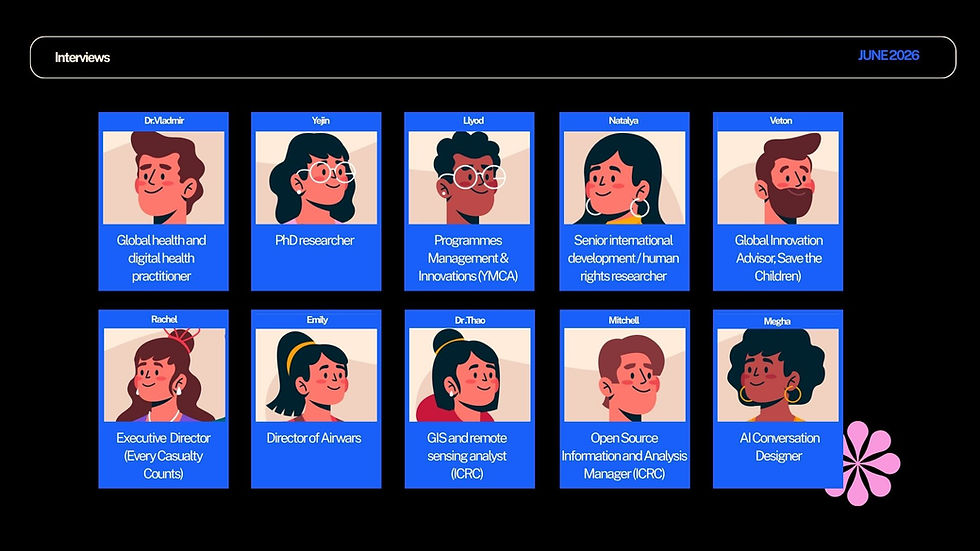
I interviewed around 10 stakeholders, including researchers/academicians, CEOs/leads from humanitarian organizations, innovation managers in this space, AI experts, and technologists, to understand:
The main idea was to understand where data gaps lie and the frustrations around them, as well as how AI comes into play given that human rights data is sensitive - including whether AI could help create data stories or report summaries to make it easier for stakeholders to use the data archive. Depending on the stakeholder, I stayed flexible with the specific questions I asked, but this was the overall layout of the interviews.
Define: I synthesised the findings from the interviews and mapped them onto an empathy map. I then conducted a thematic analysis by identifying key insights, translating them into codes, and clustering related codes to identify broader themes and patterns.
Project Timeline
Week 1: Understand the full ecosystem (actors + frontstage/backstage + workflows)
Week 2 - 3: Identify gaps in-between the data ecosystem
Week 3 - 4: Co-design value-creation map + actors map (flows, roles, tools) + data navigation
Week 4 - 5: Synthesize workshop insights
Week 5 - 8: Test and validate end-to-end service + UX